Date :03-Oct-2026
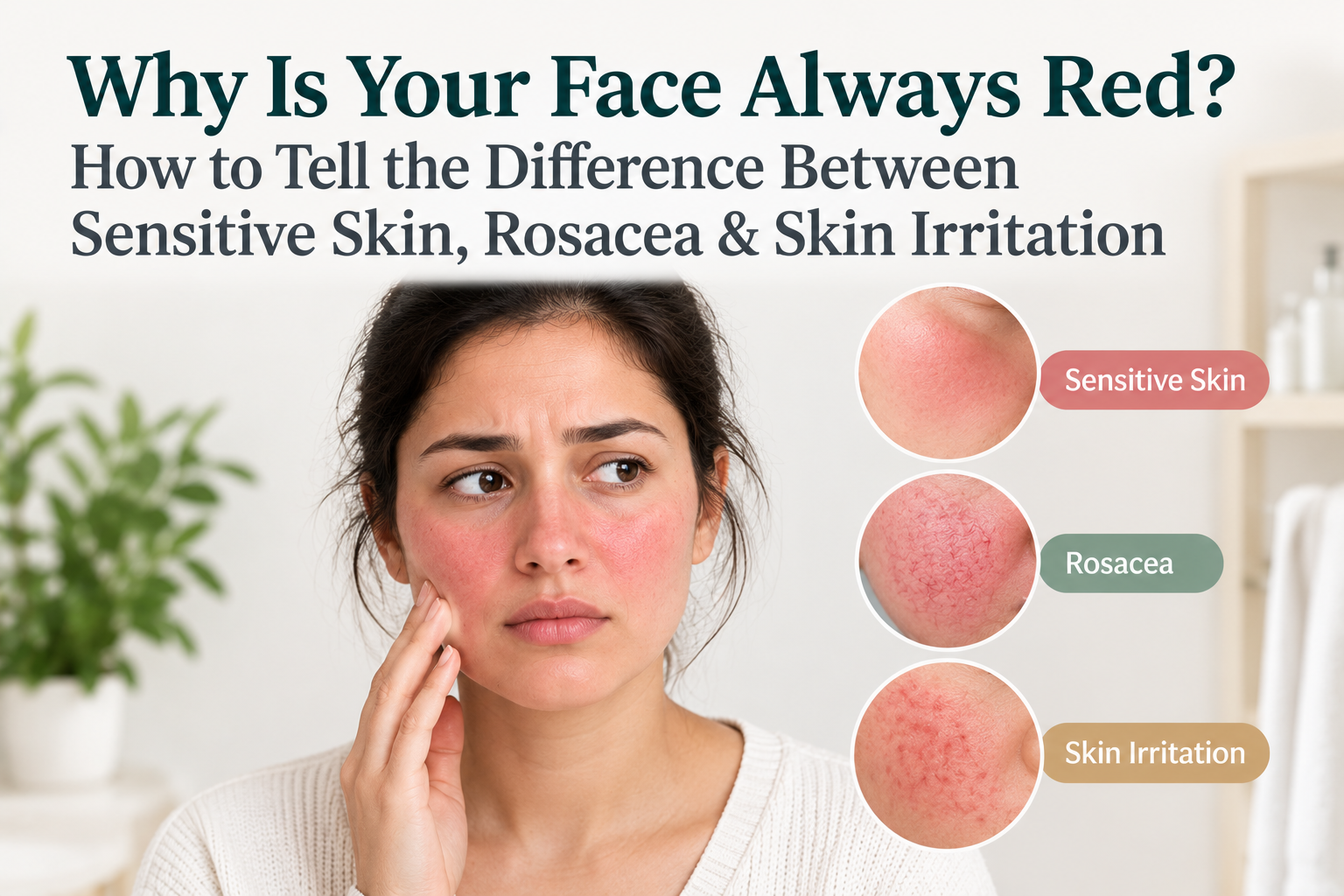
Have you noticed that your cheeks, nose or chin often look red even when you haven’t been exercising or standing in the heat?
For some people, facial redness appears occasionally after using a skincare product. For others, it keeps returning, becomes more noticeable with heat or sunlight, or is accompanied by burning, stinging, itching or small bumps.
Facial redness is common, but it does not always have the same cause.
What looks like “sensitive skin” may sometimes be irritation, an allergic reaction, acne-related inflammation or a condition such as rosacea.
Understanding the pattern of your redness is the first step towards choosing the right treatment.
Facial Redness Is Not Always Just Sensitive Skin
Skin can become temporarily red for completely normal reasons.
For example, blood vessels naturally widen when you are:
- Exercising
- Feeling embarrassed or stressed
- Exposed to heat
- Moving between hot and cold environments
- Eating very spicy food
- Spending time in the sun
This type of flushing usually settles once the trigger is removed.
The concern is when redness becomes frequent, persistent or progressively more noticeable.
Persistent facial redness deserves a closer look because different skin conditions can look surprisingly similar.
A Simple Way to Understand Facial Redness
Instead of immediately asking, “Which cream should I use?”, start by asking four questions:
1. Where does the redness appear?
Is it mainly:
- Across both cheeks?
- Around the nose?
- On the chin?
- Around the mouth?
- In isolated patches?
- Across the entire face?
The location can provide useful clues.
2. How long does it last?
Does the redness disappear within minutes?
Does it remain for several hours?
Or is your face almost always slightly red?
Persistent redness is different from occasional flushing.
3. What does your skin feel like?
Pay attention to symptoms such as:
- Burning
- Stinging
- Itching
- Tightness
- Warmth
- Pain
- Dryness
The sensation can be as important as the appearance.
4. What else appears with the redness?
Look for:
- Small red bumps
- Pus-filled pimples
- Visible blood vessels
- Scaling
- Dry patches
- Swelling
- Flaking
- Eye irritation
These accompanying signs can help a dermatologist narrow down the possible cause.
Sensitive Skin, Irritated Skin or Rosacea?
These terms are often used interchangeably, but they are not the same.
Sensitive Skin
Sensitive skin describes skin that tends to react easily to environmental conditions or skincare products.
You may experience:
- Stinging after applying products
- Burning sensations
- Tightness
- Temporary redness
- Discomfort after cleansing
Sensitive skin can occur without a specific skin disease.
However, repeatedly reacting to products does not mean you should simply keep changing products. An underlying condition may sometimes be responsible.
Skin Irritation
Irritation can occur when something damages or disrupts the skin’s protective barrier.
Common triggers include:
- Strong exfoliating acids
- Retinoids
- Fragrances
- Harsh cleansers
- Over-exfoliation
- Excessive scrubbing
- Frequent use of multiple active ingredients
- Certain cosmetic products
Irritated skin may become red, dry, itchy, burning or flaky.
If the trigger is removed and the skin is allowed to recover, mild irritation may gradually improve.
Rosacea
Rosacea is a chronic inflammatory skin condition that commonly affects the central face.
It may cause:
- Persistent facial redness
- Episodes of flushing
- Visible small blood vessels
- Burning or stinging
- Red bumps or pustules
- Increased sensitivity
The cheeks, nose, chin and central forehead can be affected.
Rosacea can sometimes be mistaken for acne because both conditions may produce red bumps.
However, treating rosacea as ordinary acne without identifying the underlying condition may not provide the expected improvement.
Could It Be Acne Instead?
Acne is another common reason for facial redness.
Inflamed acne lesions can appear as:
- Red papules
- Pustules
- Nodules
- Cysts
Unlike general facial flushing, acne usually presents as individual inflammatory lesions rather than uniform redness across the central face.
Acne may also be associated with blackheads and whiteheads.
The distinction matters because acne and rosacea do not always require the same treatment approach.
What About an Allergic Reaction?
An allergic contact reaction can also cause facial redness.
It may occur after exposure to:
- Cosmetics
- Fragrances
- Hair products
- Skincare ingredients
- Hair dyes
- Certain topical medications
Possible symptoms include:
- Itching
- Redness
- Swelling
- Burning
- Scaling
- Blistering in more severe reactions
If facial swelling is sudden or severe, particularly if accompanied by difficulty breathing or swelling of the lips or tongue, urgent medical attention is required.
Quick Comparison: What Might Your Redness Look Like?
|
Pattern
|
Possible clue
|
|
Temporary redness after heat or exercise
|
Normal flushing
|
|
Burning after a new skincare product
|
Possible irritation
|
|
Itchy redness after a cosmetic product
|
Possible contact reaction
|
|
Persistent central facial redness
|
Possible rosacea
|
|
Red individual pimples with blackheads/whiteheads
|
More consistent with acne
|
|
Redness with scaling around the nose/eyebrows
|
Possible dermatitis
|
|
Redness with visible tiny blood vessels
|
May occur with rosacea or other vascular changes
|
This table is only a guide. Appearance alone cannot establish a diagnosis.
Myth vs Fact: Facial Redness
Myth 1: “Redness always means sensitive skin.”
Fact: Facial redness can have several causes, including irritation, acne, dermatitis, rosacea and normal flushing.
Myth 2: “If my face is red, I should scrub it.”
Fact: Scrubbing can increase irritation and make redness more noticeable, particularly when the skin barrier is already compromised.
Myth 3: “Rosacea is just adult acne.”
Fact: Rosacea and acne are different conditions, although they can sometimes appear similar.
Myth 4: “Natural products cannot irritate the skin.”
Fact: Natural ingredients can still cause irritation or allergic reactions. “Natural” does not automatically mean suitable for every skin type.
Myth 5: “If a product burns, it must be working.”
Fact: Burning is not proof that a skincare product is effective. Persistent burning or irritation may indicate that the skin is reacting adversely.
Myth 6: “Sunscreen is only needed in summer.”
Fact: Ultraviolet exposure occurs throughout the year. Sun exposure can also aggravate some forms of facial redness and pigmentation.
Common Mistakes People Make When Their Face Turns Red
Using Too Many Active Ingredients
People often respond to redness by adding another serum or treatment product.
This can make the situation worse.
Using several active ingredients simultaneously can increase irritation, particularly if the skin barrier is already compromised.
Changing Products Too Frequently
Trying a new cleanser, serum, cream and treatment every few days makes it difficult to determine what is actually helping or causing the reaction.
A simple, consistent routine is usually easier to assess.
Scrubbing the Red Areas
Facial redness is not dirt that needs to be scrubbed away.
Physical scrubbing can increase friction and irritation.
Applying Home Remedies Without Knowing the Cause
Lemon juice, baking soda, undiluted essential oils and other strong DIY remedies can irritate facial skin.
A remedy that works for one person may be unsuitable for another.
Treating Every Red Bump as Acne
Not every red bump is acne.
Some may be related to rosacea, folliculitis, dermatitis or another condition.
The correct diagnosis matters before starting treatment.
What Can You Do at Home?
If your skin is mildly irritated and there are no severe symptoms, simplify your routine.
Morning
Gentle cleanser → moisturiser → broad-spectrum sunscreen
Night
Gentle cleanser → moisturiser
Avoid introducing multiple new products while your skin is irritated.
You may also benefit from:
- Avoiding harsh scrubs
- Limiting unnecessary exfoliation
- Avoiding very hot water on the face
- Using gentle skincare products
- Protecting your skin from excessive sun exposure
- Keeping track of products that trigger redness
If redness repeatedly returns, do not keep treating it as temporary irritation without finding the cause.
When Should You See a Dermatologist?
Occasional flushing is usually not a reason for concern.
However, consider a dermatology consultation if you notice:
- Redness that persists for weeks
- Frequent episodes of facial flushing
- Burning or stinging
- Visible tiny blood vessels
- Recurrent red bumps
- Persistent itching
- Facial swelling
- Repeated reactions to skincare products
- Redness that is becoming progressively worse
- Eye irritation associated with facial redness
- Skin changes that do not improve after stopping an irritating product
A dermatologist can examine the pattern, distribution and associated symptoms to determine the likely cause.
Can Facial Redness Be Treated?
Yes, but treatment depends entirely on the cause.
There is no single “anti-redness cream” that is appropriate for every person.
Depending on the diagnosis, treatment may involve:
- Trigger avoidance
- Barrier-supportive skincare
- Prescription topical medication
- Treatment for acne or dermatitis
- Specific therapy for rosacea
- Management of visible blood vessels
- Laser or light-based procedures in selected cases
- Treatment of an underlying inflammatory skin condition
The objective is not simply to cover redness with makeup.
The goal is to identify why the redness is occurring and treat the underlying problem.
Facial Redness Treatment in Bangalore
If persistent redness, burning, sensitivity or recurrent facial bumps are affecting your skin, professional evaluation can help identify whether the problem is related to sensitive skin, irritation, acne, rosacea, dermatitis or another condition.
Dr. Priya’s Skin & Hair Clinic in Marathahalli, Bangalore, provides dermatological care for a range of skin concerns, including acne, rosacea, eczema, itching and allergies. Dr. Priya’s Skin & Hair Clinic
Patients from Marathahalli, Whitefield, Brookefield, Bellandur and nearby areas can seek a dermatological assessment when persistent facial redness or other skin symptoms require evaluation.
A Simple Self-Check Before Your Appointment
Before consulting a dermatologist, make a note of:
When did the redness start?
Where does it appear?
How long does each episode last?
Does heat or sunlight make it worse?
Does spicy food trigger flushing?
Which skincare products were introduced recently?
Is there itching, burning or stinging?
Are there bumps, pimples or visible blood vessels?
Does the redness improve when you stop certain products?
This information can help your dermatologist understand the pattern more clearly.
Frequently Asked Questions
1. Why is my face red even when I am not using skincare?
Facial redness can have several causes, including flushing, rosacea, dermatitis, acne or environmental triggers. Persistent redness should be assessed rather than automatically attributed to skincare.
2. Can sensitive skin become rosacea?
Sensitive skin and rosacea are not the same diagnosis. People with rosacea may have highly reactive skin, but sensitivity alone does not mean someone has rosacea.
3. Does spicy food cause rosacea?
Spicy foods can trigger flushing in some people with rosacea, but triggers vary between individuals.
4. Can sunscreen cause facial redness?
Some sunscreen formulations may irritate sensitive skin or cause contact reactions in susceptible individuals. If redness repeatedly occurs after applying a particular sunscreen, discuss alternatives with a dermatologist.
5. Can facial redness disappear permanently?
The answer depends on its cause. Temporary flushing may resolve on its own, while chronic conditions such as rosacea may require ongoing management.
6. Should I stop all skincare if my face becomes red?
Not necessarily. Completely stopping everything may not be required. A dermatologist can help identify potential irritants and recommend a suitable simplified routine.
7. Can rosacea cause pimples?
Yes. Some forms of rosacea can produce red bumps and pustules, which is one reason it may be confused with acne.
8. Can facial redness leave pigmentation?
Inflammation and irritation can sometimes be followed by post-inflammatory pigmentation, particularly in deeper skin tones.
9. Is facial redness always a medical problem?
No. Normal flushing from exercise, heat or emotional changes can be completely normal. The concern is persistent, recurrent or symptomatic redness.
10. When should I get facial redness checked?
If redness persists, repeatedly returns, burns, itches, develops bumps or visible blood vessels, or does not improve after avoiding an obvious irritant, consider consulting a dermatologist.
Final Takeaway
A red face does not automatically mean sensitive skin.
The pattern matters.
Temporary flushing, product irritation, acne, dermatitis and rosacea can all produce redness, but they are not the same condition and should not automatically be treated in the same way.
Instead of repeatedly changing creams or trying home remedies, pay attention to where the redness appears, how long it lasts, what triggers it and which symptoms occur alongside it.
If facial redness is persistent or keeps returning, a dermatologist can help identify the underlying cause and recommend an appropriate treatment plan.
When it comes to facial redness, the right diagnosis comes before the right treatment.
For persistent redness, burning, sensitivity, recurrent bumps or other unexplained skin changes, consult a qualified dermatologist for personalised evaluation.