Date :30-Sep-2026
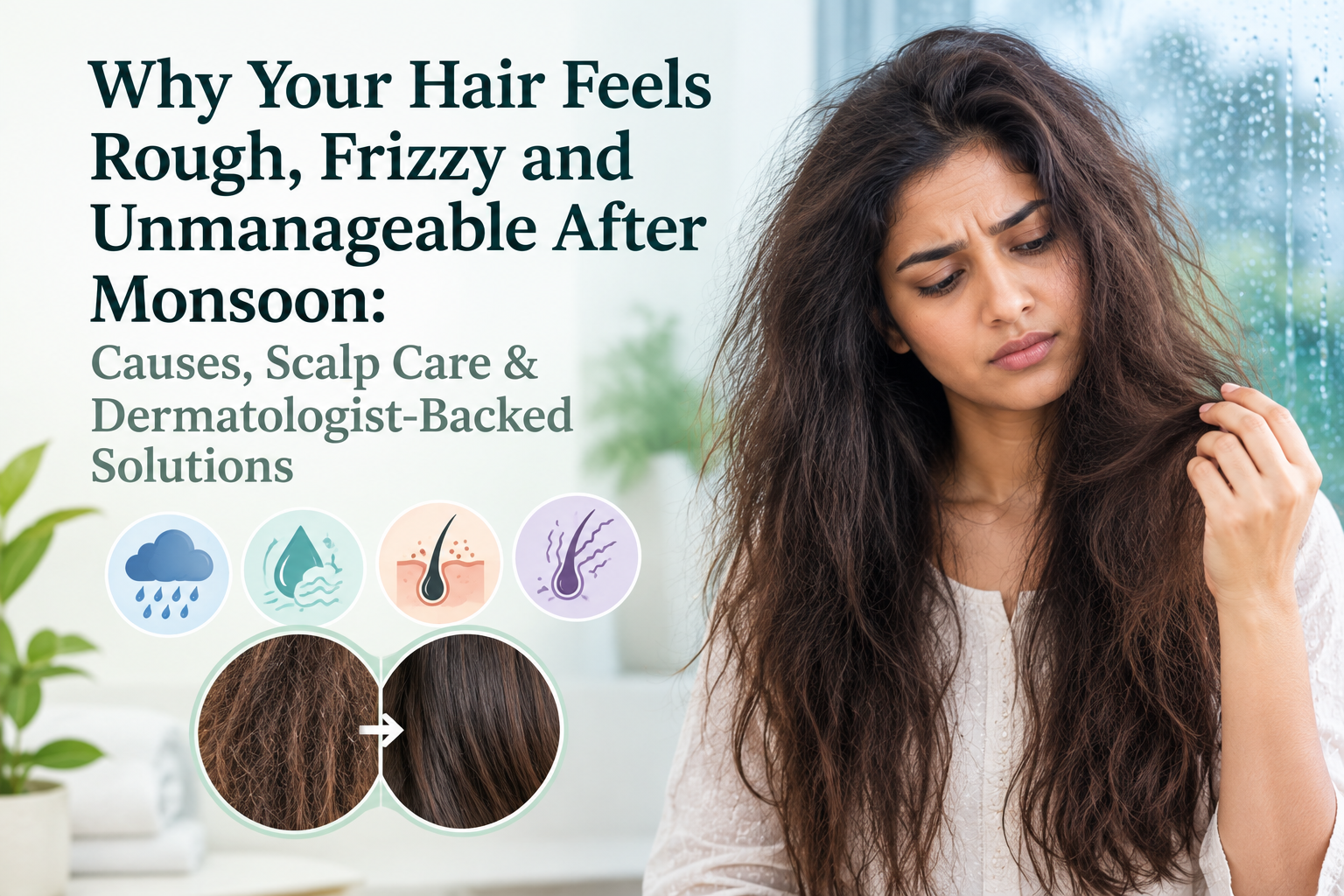
The monsoon may bring relief from the heat, but your hair and scalp can experience the opposite. Increased humidity, repeated exposure to moisture, sweating, pollution and frequent washing can leave hair feeling rough, frizzy, tangled and difficult to manage.
Many people notice that their hair looks dull, loses its smoothness or becomes increasingly difficult to style as the rainy season progresses. Some may also experience scalp itching, dandruff, excess oiliness or increased hair breakage.
But why does this happen, and what can you do about it?
The important thing is to understand the difference between hair-shaft damage, scalp problems and true hair loss. Each has a different cause and may require a different approach.
Why Does Hair Become Frizzy During and After Monsoon?
Humidity is one of the biggest reasons hair becomes frizzy during the rainy season.
Hair contains a protein called keratin and has a protective outer layer known as the cuticle. When the hair shaft absorbs excess moisture from humid air, the structure of the hair can change temporarily.
This can make the hair:
- Look puffy or frizzy
- Become difficult to style
- Feel rough or dry
- Tangle more easily
- Lose its smooth appearance
- Become more prone to breakage when handled roughly
People with naturally curly, wavy or chemically treated hair may notice these changes more prominently.
However, persistent frizz is not necessarily a sign that your hair is unhealthy from the root. Often, it is a combination of humidity, hair-shaft damage and the way the hair is handled.
7 Reasons Your Hair May Feel Rough After Monsoon
1. Repeated Wetting and Drying
Getting caught in the rain, washing the hair frequently and repeatedly allowing it to dry can increase stress on the hair shaft.
Wet hair is more vulnerable to mechanical damage. Vigorous rubbing, aggressive brushing or tying the hair tightly while wet can increase breakage.
2. Humidity
High humidity allows the hair to absorb more moisture from the surrounding environment.
This can disrupt the smooth appearance of the hair cuticle and make the strands look frizzy and unruly.
Humidity itself does not permanently damage the hair follicles, but it can make existing hair-shaft damage more noticeable.
3. Frequent Heat Styling
Many people use straighteners, curling irons or blow dryers to control frizz.
Although these methods can temporarily make hair look smoother, frequent exposure to high heat can damage the hair shaft over time.
Signs of heat-related hair damage can include:
- Split ends
- Rough texture
- Increased breakage
- Loss of shine
- Hair that feels unusually dry
4. Aggressive Towel Drying
Rubbing wet hair vigorously with a towel may create friction between the hair strands.
Instead of rubbing, gently squeeze excess water from the hair and allow it to dry naturally whenever possible.
5. Tight Hairstyles
Tight ponytails, buns and braids can place repeated tension on the hair.
When performed frequently, hairstyles that pull strongly on the scalp can contribute to traction-related hair damage and, in some cases, hair loss around areas of repeated tension.
6. Excessive Product Buildup
During humid weather, people often use multiple products such as serums, oils, creams, leave-in conditioners and styling products to control frizz.
Using too many products without appropriate cleansing can leave the hair and scalp feeling heavy or greasy.
If your scalp is oily, itchy or flaky, the problem may not simply be dry hair. It could indicate an underlying scalp condition that needs appropriate care.
7. Scalp Conditions
Dandruff, seborrhoeic dermatitis, folliculitis and other scalp conditions can become noticeable during periods of increased sweating and humidity.
Symptoms such as persistent itching, redness, scaling, pain or pus-filled bumps should not be dismissed as ordinary seasonal changes.
Dr. Priya’s Skin & Hair Clinic notes that inadequate scalp cleansing can contribute to accumulation of oils and dead skin cells, while conditions such as dandruff may require specific medicated treatment. (Dr. Priya’s Skin and Hair Clinic)
Frizzy Hair vs Hair Fall: They Are Not the Same
One of the most common misconceptions is that frizzy hair automatically means increased hair fall.
It does not.
Hair frizz generally involves the hair shaft becoming rough, dry, expanded or difficult to control.
Hair fall, on the other hand, refers to shedding of hair from the follicle.
Hair breakage occurs when the hair shaft breaks somewhere along its length.
These three problems can occur together, but they are not identical.
For example, someone may notice many short strands around the shoulders and assume they are losing hair from the roots. In reality, some may be broken pieces of damaged hair.
A dermatologist can help distinguish between shedding, breakage and an actual hair-loss disorder.
How to Care for Your Hair During September
Keep Your Scalp Clean
There is no universal rule that everyone must wash their hair on a particular number of days per week.
Your washing frequency should depend on your scalp type, sweating, oiliness and any existing scalp condition.
If your scalp becomes oily or sweaty quickly, appropriate cleansing can help remove excess oil, sweat and accumulated debris.
Avoid avoiding shampoo simply because you believe washing automatically causes hair fall.
Dry Your Hair Properly
If your hair becomes wet in the rain:
- Gently remove excess water.
- Avoid vigorous towel rubbing.
- Do not tightly tie soaking-wet hair.
- Allow the scalp to dry properly.
- Avoid aggressive brushing while the hair is very wet.
Reduce Excessive Heat
Try to minimise frequent use of:
- Hair straighteners
- Curling irons
- High-temperature blow dryers
- Repeated heat styling
If you need to use a dryer, avoid excessive heat and prolonged exposure to one section of hair.
Avoid Tight Hairstyles
Give your hair a break from hairstyles that continuously pull on the scalp.
Looser hairstyles can reduce unnecessary tension on the hairline and scalp.
Be Careful While Detangling
Wet hair is more vulnerable to mechanical stress.
Use gentle handling and avoid forcefully pulling through knots.
Start detangling from the ends and gradually work towards the roots.
Choose Products According to Your Hair and Scalp
A product that works well for one person may not be suitable for another.
Someone with a dry, curly hair shaft may need more conditioning, while someone with an oily scalp and dandruff may require a different cleansing strategy.
If you have persistent scalp symptoms, changing cosmetic products repeatedly may not solve the underlying problem.
Does Oiling Help Frizzy Hair?
Hair oiling can improve manageability and reduce friction between hair strands for some people.
However, oiling is not a treatment for every type of hair or scalp problem.
If you have an oily scalp, dandruff or folliculitis, excessive oiling may make the scalp feel heavier or worsen discomfort in some individuals.
Most importantly, oiling cannot treat medical causes of hair loss such as pattern hair loss, certain inflammatory scalp conditions or nutritional deficiencies.
The right approach depends on why the hair or scalp is unhealthy.
Can Conditioner Reduce Frizz?
Conditioning can help improve the feel and manageability of the hair by reducing friction between strands.
It can be particularly useful for dry, coarse or chemically treated hair.
However, conditioner should generally be applied to the hair lengths rather than heavily applied to an oily scalp unless specifically advised otherwise.
If your hair remains extremely dry, brittle or prone to breakage despite appropriate hair care, professional evaluation may help identify whether there is significant hair-shaft damage or an underlying scalp issue.
When Is Frizz Actually a Sign of Hair Damage?
Occasional frizz caused by humidity is common.
However, persistent roughness accompanied by other changes may indicate significant hair-shaft damage.
Look for:
- Frequent split ends
- Excessive breakage
- Very rough texture
- Loss of natural shine
- Hair that breaks easily while combing
- Increased tangling
- Short broken strands throughout the hair
Repeated chemical treatments, bleaching, colouring, heat styling and mechanical stress can contribute to this type of damage.
A dermatologist can help determine whether your concern is primarily cosmetic hair damage or associated with a scalp or hair-growth disorder.
What About Dandruff During Humid Weather?
Dandruff can cause:
- White or yellowish flakes
- Itching
- Greasy scalp
- Redness
- Scalp irritation
Dandruff is not simply caused by having a “dirty scalp.” Factors including scalp oil, skin-cell turnover and the yeast Malassezia can contribute.
If dandruff is persistent, severe or repeatedly returning, a dermatologist may recommend an appropriate medicated shampoo or other treatment depending on the diagnosis.
Avoid scratching aggressively, as repeated scratching can further irritate the scalp.
When Should You See a Dermatologist?
Not every case of frizzy or rough hair requires medical treatment.
However, a dermatological evaluation is advisable when hair changes are accompanied by:
- Sudden or excessive hair shedding
- Noticeable thinning
- Widening hair part
- Receding hairline
- Bald patches
- Persistent scalp itching
- Redness or burning
- Thick scaling
- Painful scalp lesions
- Pus-filled bumps
- Severe or persistent dandruff
- Hair breakage that continues despite improving hair-care habits
These symptoms may indicate an underlying condition rather than simple weather-related frizz.
Hair and Scalp Treatment in Bangalore
If your hair has become increasingly difficult to manage, do not assume that humidity is the only explanation.
A dermatologist can examine the scalp and hair pattern to distinguish between:
- Hair-shaft damage
- Hair breakage
- Dandruff
- Seborrhoeic dermatitis
- Scalp inflammation
- Pattern hair loss
- Telogen effluvium
- Other causes of hair thinning
The appropriate treatment depends on the diagnosis.
Dr. Priya’s Skin & Hair Clinic in Marathahalli, Bangalore, provides dermatological and hair-related care, including treatment for conditions such as hair loss, dandruff, female pattern hair loss, male pattern hair loss and other scalp concerns. (Dr. Priya’s Skin and Hair Clinic)
Frequently Asked Questions
1. Why does my hair become frizzy during monsoon?
Higher humidity can increase moisture absorption by the hair shaft, making the hair appear puffier, rougher and more difficult to control.
2. Does humidity cause permanent hair damage?
Humidity can worsen the appearance and manageability of hair, but humidity alone does not necessarily cause permanent follicle damage. Existing hair-shaft damage and styling habits can make frizz more noticeable.
3. Should I wash my hair more often during monsoon?
There is no fixed frequency for everyone. If your scalp becomes oily or sweaty, more frequent cleansing may be appropriate depending on your scalp condition and hair type.
4. Does rainwater cause hair fall?
Getting wet in the rain does not automatically cause permanent hair loss. However, prolonged dampness, rough handling of wet hair and scalp irritation can contribute to breakage or scalp problems.
5. Can I oil my hair if I have dandruff?
Oiling does not treat every cause of dandruff. If you have persistent flakes, itching or scalp inflammation, it is better to identify the underlying condition before relying on oiling.
6. Does cutting hair reduce hair fall?
No. Cutting the hair changes the length of the hair shaft but does not alter the biological growth cycle of the follicle.
7. Why is my hair breaking but not falling from the root?
Hair breakage occurs along the shaft and may result from heat, chemical treatments, friction, tight hairstyles or mechanical damage. A dermatologist can help distinguish breakage from true hair shedding.
8. Can dandruff cause hair loss?
Persistent scalp inflammation, itching and scratching can contribute to increased shedding in some people. Significant or persistent hair loss should be evaluated rather than attributed to dandruff alone.
9. How can I reduce frizz naturally?
Gentle handling, appropriate conditioning, reducing excessive heat and avoiding aggressive brushing of wet hair can help reduce unnecessary hair-shaft stress.
10. When should I consult a dermatologist for hair problems?
Seek professional evaluation if you notice persistent hair fall, visible thinning, bald patches, severe dandruff, scalp pain, redness, scaling, itching or other persistent scalp symptoms.
Final Takeaway
September can be a challenging month for hair because the effects of humidity, rain exposure, sweating and repeated wetting may continue even as the weather begins to change.
The solution is not simply to use more hair products.
Focus on scalp hygiene, gentle hair handling, appropriate conditioning, reduced heat exposure and avoiding excessive tension on the hair.
Most importantly, remember that frizz, breakage and hair loss are different problems. If you are experiencing persistent shedding, thinning or scalp symptoms, identifying the underlying cause is more important than trying multiple home remedies.
Healthy hair begins with a healthy scalp and the right diagnosis.
For persistent hair fall, scalp concerns or significant changes in hair texture, consult a qualified dermatologist for personalised evaluation and treatment.